
Marketing
Choosing a Specialist: Freelancer vs. Social Media Agency – 7 key differences you should know before deciding
Compare costs, quality, flexibility and scalability of cooperation.
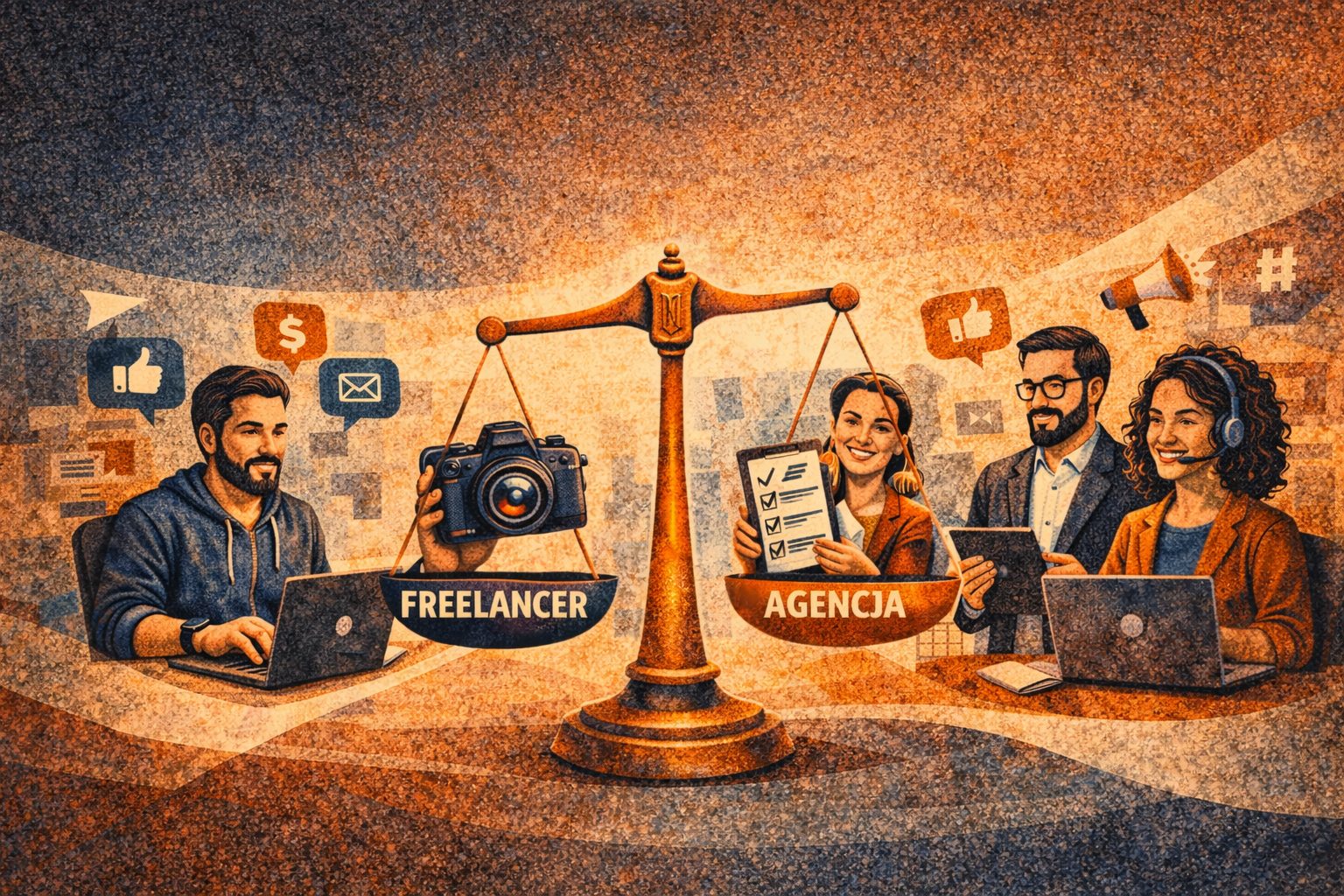
In today’s digital world, presence on social media is no longer an option – it is a necessity. Companies of all sizes invest in Facebook, Instagram, LinkedIn or TikTok to build brand awareness, acquire customers and increase sales. This is where a key question appears: who should handle your social media?
The dilemma Choosing a Specialist: Freelancer vs. Social Media Agency – 7 key differences you should know before deciding applies to both startups and mature companies. Each solution has its pros and cons, and a wrong decision can cost not only money but also missed business opportunities.
Why the choice between a freelancer and a social media agency matters
Choosing a partner for social media activities directly affects:
- brand communication consistency,
- quality of published content,
- effectiveness of advertising campaigns,
- speed of reacting to trends and crises.
It is not just about price. It is a strategic decision that can accelerate company growth or… effectively slow it down.
Freelancer vs. Social Media Agency – basic definitions
Who is a social media freelancer
A freelancer is an independent specialist who provides social media profile management services on their own. Most often they deal with:
- creating posts,
- planning publications,
- basic analytics,
- communication with the client.
Their huge advantage is direct contact and flexibility.
What is a social media agency
A social media agency is a team of experts: strategists, graphic designers, copywriters and ad specialists. They work according to established processes and offer comprehensive service – from strategy to reporting results.
7 key differences you should know before deciding
1. Cooperation costs
Freelancer billing model
Freelancers usually offer:
- lower monthly fees,
- hourly billing,
- flexible packages.
This is a good option for companies with limited budgets.
Agency pricing model
Agencies are more expensive, but the price includes:
- team work,
- premium tools,
- strategy and analytics.
Costs are often the first selection criterion, but they should not be the only one. Freelancers usually offer lower rates because they do not bear the costs of a team, office or advanced tools. This makes them attractive for small businesses and startups that want to start social media activities without large investments.
Social media agencies have higher prices, but they include the work of several specialists at once and access to paid analytics and advertising tools.
Example: A freelancer may cost 1,500–2,500 PLN per month for profile management, while an agency 4,000–8,000 PLN, but at that price you get strategy, graphics, ads and reports.
2. Scope of services and competencies
A freelancer usually specializes in a few areas – e.g. content creation and post planning. However, they may lack advanced knowledge of ads, analytics or branding. This means that for more complex projects it may be necessary to engage additional specialists.
An agency provides comprehensive service in one place. Each element – from strategy to creation and performance analysis – is handled by a person specialized in a given field.
Example: If you want to run Instagram, LinkedIn and Meta Ads campaigns at the same time, an agency will do it coherently, while a freelancer may struggle to handle all channels at a high level.
3. Flexibility and speed of action
Freelancers are usually very flexible. They react faster to changes, trends or urgent needs because they make decisions independently. This is a huge advantage in the dynamic social media environment.
Agencies operate according to established processes and schedules, which increases quality and predictability, but sometimes slows reaction.
Example: If a viral trend suddenly appears and you want to use it “right away”, a freelancer can publish a post the same day, while an agency may need approvals from several people.
4. Scalability of marketing activities
If you plan dynamic growth, an agency will handle better:
- a larger number of campaigns,
- multiple channels,
- an increase in advertising budget.
A freelancer has limited time resources. When the number of projects grows, their availability may decrease, affecting quality and timeliness.
Agencies are built to scale. They can handle larger advertising budgets, more campaigns and channels without losing quality.
Example: If you plan to increase an ad budget from 2,000 PLN to 20,000 PLN per month, an agency will more easily adjust strategy and resources to such growth.
5. Communication and availability
Freelancer = one contact, quick responses.
Agency = account manager, but sometimes longer response time.
Working with a freelancer means direct contact with the person executing the project. This simplifies communication and shortens response time. At the same time, the freelancer’s availability may be limited, e.g. by other projects.
In an agency you usually communicate with an account manager who coordinates the team. This adds order but sometimes prolongs the information flow.
Example: A freelancer responds on WhatsApp in an hour, an agency – according to agreed SLA, e.g. up to 24 hours.
6. Safety and continuity of cooperation
This is one of the most overlooked yet very important aspects. If a freelancer gets sick, travels or ends cooperation, social media activities may be paused.
An agency ensures continuity – if one person is absent, their tasks are taken over by another team member.
Example: During a long weekend or a specialist’s vacation in an agency, campaigns still run, posts are published and comments are moderated.
7. Responsibility and strategic approach
Freelancers often focus on day-to-day tasks: posts, graphics and schedules. Strategy can be simplified or short-term.
Agencies look broader – they analyze the market, competition and business goals and build a long-term communication strategy.
Example: A freelancer plans posts for a month, while an agency develops a strategy for a quarter or a year, including sales goals, marketing funnels and KPIs.
When a freelancer is the better choice
A social media freelancer can be a very good solution, provided the choice is conscious and adapted to the stage of company development. In many cases, an independent specialist provides the best value for money and greater flexibility.
1. When you run a small business or startup
If you are just starting or running a micro business, your main goal is to build a social media presence without excessive costs. A freelancer allows you to enter online marketing gradually without investing large budgets from the first month.
Example: A local café or a new service brand can start cooperation with a freelancer who handles regular posts, stories and basic customer communication.
2. When you have a limited marketing budget
Budget is one of the key decision factors. Freelancers offer lower rates, flexible packages and hourly billing, giving you greater control over expenses.
For many companies this is a safe way to test social media activities without long-term commitments.
Example: Instead of signing a 6- or 12-month contract with an agency, you can start monthly cooperation with a freelancer and evaluate results after a few weeks.
3. When you need high flexibility and quick decisions
A freelancer works independently, without complex decision processes. This allows them to quickly respond to:
- trend changes,
- current events,
- urgent communication needs.
This is especially important in dynamic industries where response time matters.
Example: If your business is based on current events (e.g., a personal trainer, online expert, course creator), a freelancer can adjust content almost “day by day”.
4. When the scope of work is clearly defined and limited
A freelancer works best when you know exactly what you need. If the scope includes:
- managing one or two profiles,
- creating posts,
- basic comment moderation,
then hiring an agency may simply be uneconomical.
Example: A B2B company running LinkedIn solely for branding does not always need a full agency team.
5. When you value direct contact
Working with a freelancer means contact with the person who actually does the work. There are no intermediaries, account managers or additional communication stages.
For many entrepreneurs this is a huge advantage because:
- it is easier to communicate the brand vision,
- it is faster to implement changes,
- it helps build a trust-based relationship.
Example: The owner of a personal brand (coach, consultant, expert) often prefers direct cooperation with one specialist rather than a whole team.
6. When you want to test a strategy or market
A freelancer is the ideal solution at the testing stage. You can:
- check which platforms work best,
- test different content formats,
- assess the sales potential of social media.
After this stage it is easier to decide whether to scale activities with an agency.
Example: An online store tests Instagram for 3 months with a freelancer and then, after getting results, decides to expand activities.
7. When you value individual approach over processes
Freelancers often work more “humanly” than process-driven. They adapt better to the brand’s communication style, tone of voice and the owner’s personality.
This is especially important for personal brands and small relationship-based businesses.
Example: A freelancer can write posts on your behalf, keeping a natural style that would be harder to reproduce in an agency.
Summary of this section
A freelancer is the better choice when:
- you are at an early stage of development,
- you have a limited budget,
- you need flexibility and quick reactions,
- you want direct cooperation,
- the scope of work does not require a large team.
This is an ideal solution for a start, tests and smaller projects that can naturally evolve toward cooperation with an agency in the future.
When a social media agency is the better fit
An agency is a better option if:
- you are scaling the business,
- you run online sales,
- you care about strategy and analysis,
- you want to build a strong brand.
Most common mistakes when choosing a specialist
- Choosing solely based on price
- Lack of clearly defined goals
- Not checking portfolio
- No contract and KPIs
How to make the final decision step by step
- Define business goals
- Set a budget
- Compare offers
- Check reviews
- Test cooperation
It can also be helpful to compare industry standards, e.g. described on the site
https://www.socialmediaexaminer.com/
FAQ – Frequently asked questions
- Is a freelancer cheaper than an agency?
Yes, but the scope of services may be limited. - Does an agency always deliver better results?
Not always – it depends on the team quality and strategy. - Can I switch from a freelancer to an agency later?
Yes, it is a common practice. - How long does agency onboarding take?
Usually 2 to 4 weeks. - Can a freelancer run paid ads?
Yes, but not everyone has advanced competencies. - What should I choose at the start of a business?
Most often a freelancer, and later an agency.
Summary and final recommendations
Choosing a Social Media specialist is a topic that should not be underestimated. A freelancer offers flexibility and lower costs, an agency – safety, scale and strategy. The best choice is the one tailored to your goals, budget and stage of company development.
If you liked this post, share it: